

Sawdust charcoal making machine offers a sustainable solution for the wood processing industry. It converts wood waste (sawdust, shavings, wood chips, etc.) into high-value biochar. With an annual output of up to 6,000 tons of EBC-certified biochar, this sawdust charcoal machine paves the way for effective carbon removal projects. Please explore more details.
Sawdust Charcoal Machine Passes Puro.earth Evaluation
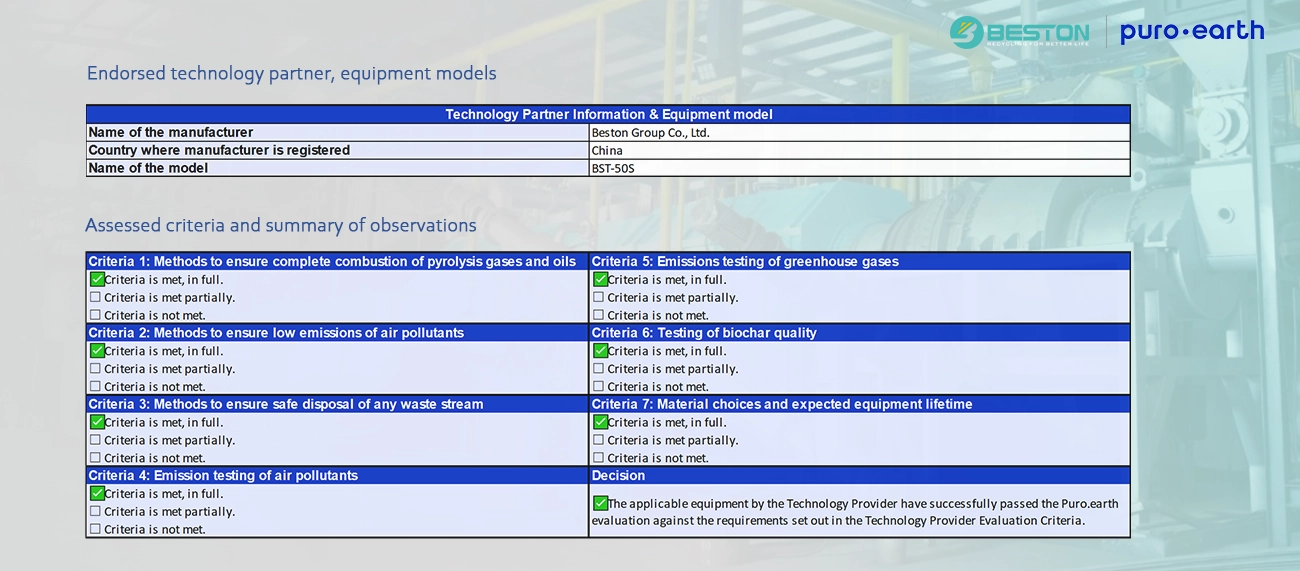
According to the Puro Standard Biochar carbon removal methodology (2022 Edition), Beston Group’s BST-50S sawdust biochar production equipment fully meets the certification requirements. Key features:
Technology Complies with CDR Criteria
The technology as a whole meets Puro.earth’s evaluation requirements for carbon dioxide removal (CDR) projects, qualifying it for carbon credit generation and trading.
Biochar Quality Meets EBC Standards
The resulting biochar offers long-term carbon sink stability (over 100 years). It is suitable for applications in agriculture, environmental restoration, and carbon credit markets.
Emissions Comply with EU Standards
Equipped with a high-efficiency gas treatment system, BST-50S achieves particulate matter, N₂O, and CH₄ emissions that are below regulatory limits.
Technical Breakthrough: 720 Hours of Continuous Operation
The BST-50S sawdust wood charcoal making machine has achieved a major milestone in pyrolysis system integration and design. This enables stable and continuous operation for up to 720 hours (30 days)—a leading performance in the industry. The following core technologies drive this breakthrough:
Sealed Combustion Chamber
Improved furnace structure and sealing design effectively reduce heat loss and prevent gas leakage, ensuring a stable reaction environment for long-term operation.
Fully Insulated Pipeline Design
Key pipelines are wrapped with multi-layer thermal insulation materials to prevent the condensation of tar and wood vinegar on pipe walls. This minimizes the risks of blockage.
Nitrogen Purging System
Nitrogen purging is applied at critical process points to prevent high-temperature dust accumulation and pipe blockage, thereby extending continuous runtime.
BST-50S Model: Maximizing Carbon Sequestration Potential
6000 Ton
biochar output per year
12000 Ton
CO2 locked per year
7200 Hour
operation time per year
> 10 m³
processing capacity per hour

Parameters of Sawdust Charcoal Making Machine

BST-50S Model

BST-06 Model
| Model | BST-50 Standard | BST-50 Max | BST-50S | BST-06 Quicker |
|---|---|---|---|---|
| Operating Mode | Continuous | Continuous | Continuous | Continuous |
| Application | Commercial-scale | Commercial-scale | Commercial-scale | Pilot Testing |
| Certification Platform | Isometric, Rainbow | Isometric, Rainbow | Puro.earth, Isometric, Rainbow | Rainbow |
| Reactor Material | Staineless Steel 304 | Staineless Steel 304 | Staineless Steel 310s | Staineless Steel 304 |
| Feedstock Moisture | Below 15% | From 15% to 55% | From 15% to 55% | Below 15% |
| Feedstock Size | 5-20mm | 5-20mm | 5-20mm | 5-20mm |
| Feeding Capacity (only for pyrolysis) | 10-15m³/h | 10-15m³/h | 10-15m³/h | 100-200KG/H |
| Max. Pyrolysis Temperature (Combustion Chamber) | 650℃ | 650℃ | 700℃ | 650℃ |
| Residue Retention Time | 15-20 minutes | 15-20 minutes | 15-20 minutes | 15-20 minutes |
| Operating Pressure | -20 - 0 pa | -20 - 0 pa | -20 - 0 pa | -20 - 0 pa |
| Cooling Method | Water | Water | Industrial Refrigeration Units | Water |
| Exhasut Gas Treatment | Standard | Standard | High Performance | Standard |
| Biochar Temperature | 45℃ | 45℃ | 45℃ | 45℃ |
| Annual Operating Hours | >7200hrs | >7200hrs | >7200hrs | >7200hrs |
| Service Life | 5-8 years | 5-8 years | 8-10 years | 5-8 years |
| Land Space Required (L*W*H*m) | 35*15*8 | 65*15*8 | 65*15*8 | 35*15*8 |
| Power Consumption | 121kw/h | 270-288kw/h | 270-304kw/h | 25.1kw/h |
| Water Consumption | 5-7m³/day | 5-7m³/day | 0 | 3-5m³/day |
| Fuel Consumption | 220-260m³/h | 220-260m³/h | 220-260m³/h | 30-50m³/day |
| Installation Period | 60 days | 60 days | 60 days | 7 days |
Common Sources of Sawdust
Sawdust (or wood dust) is a by-product or waste product of woodworking operations such as sawing, sanding, milling and routing. It is composed of very small chips of wood. Here are some common sources of sawdust: