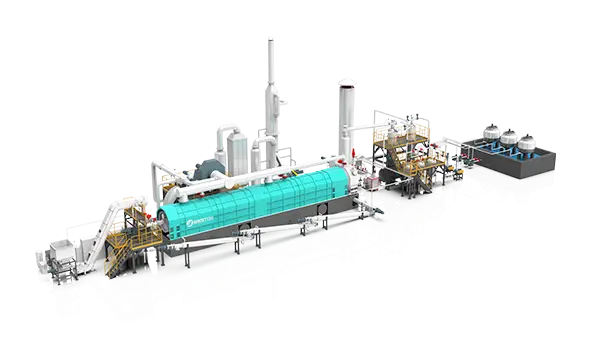
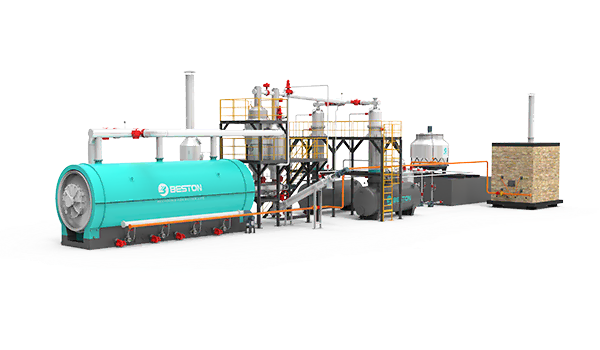
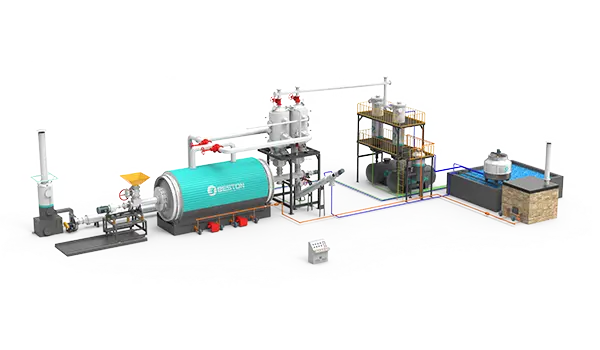
A plastic pyrolysis plant heats waste plastic to 300-600°C in an oxygen-free environment, converting it into pyrolysis oil, syngas, and solid residue. Instead of going to landfill or ending up in the ocean, plastic waste becomes fuel and chemical feedstock, helping businesses turn a disposal cost into a revenue stream while reducing plastic pollution.
Parameters of Plastic Pyrolysis Plant for Sale

Continuous Type: Blackgold P30
- Process 6,000 tons of plastic waste annually
- 30-day continuous pyrolysis operation
- High automation: 4 operators required
- Get light oil & non-standard diesel
- Policy support and incentives
- Easy to get environmental compliance and approval

Blackgold P30

BLJ-20

BLJ-16
| Model | Blackgold P30 | BLJ-20 | BLJ-16 Standard | BLJ-16 WAX | BLJ-16 CAT | BLJ-16 ULTRA |
|---|---|---|---|---|---|---|
| Manufacturer | BESTON | BESTON | BESTON | BESTON | BESTON | BESTON |
| Time to Market | 2026 | 2025 | 2013 | 2022 | 2022 | 2022 |
| Motor Brand | Chinese brand | Chinese brand | Chinese brand | Chinese brand | Chinese brand | ABB Explosion-proof |
| Suitable Raw Materials | Waste plastics; Tires; Oil sludge | Waste plastics; Tires; Oil sludge | Whole tire<120cm; Tire blocks<15cm; Oil soil with liquid content<30% | Waste plastic bales (Max.0.9*0.9*1.6m) | Waste plastic bales (Max.0.9*0.9*1.6m) | Waste plastics; Tires; Oil sludge |
| Input Capacity (Max.) | Waste plastic pellets: 0.8-1.05t/h; Rubber powder: 1.25-1.5t/h; Oil sludge:1.8-2.3t/h | Waste plastic pellets: 12-13t/d; Tire: 18-20t/d; Oil sludge:20-25t/d | Whole tire <120cm or Tire blocks<15cm: 10-12t/batch; Sidewall removed tire: 15-16t/batch; Oil soil: 16-18t/batch | 8-10t/batch | 8-10t/batch | Waste plastic bales: 8-10t/batch; Whole tire <120cm or Tire blocks<15cm: 10-12t/batch; Sidewall removed tire: 15-16t/batch; Oil sludge: 16-18t/batch |
| Working Method | Fully Continuous | Batch | Batch | Batch | Batch | Batch |
| Final Oil Quality | Pyrolysis oil; Pyrolysis oil with wax or light oil; Gasoline blending components | Pyrolysis oil; Light oil and non-standard diesel | Pyrolysis oil | Pyrolysis oil with wax | Pyrolysis oil with light oil | Pyrolysis oil; Pyrolysis oil with wax or light oil |
| Reactor Material | 304/310S Stainless steel | Q345R Boiler steel and 304/316L/310S Stainless steel | Q345R Boiler steel | 304 Stainless steel | 304 Stainless steel | 304 Stainless steel |
| Reactor Life Span (Years) | 5-8 Years | Q345R Boiler steel: 2-3 Years; 304/316L Stainless steel: 5-8 Years; 310S Stainless steel: 8-10 Years | 2-3 Years | 5-8 Years | 5-8 Years | 5-8 Years |
| Guarantee (Months) | 12 | 12 | 12 | 12 | 12 | 12 |
| Delivery Time (Calendar Days) | 60-90 | 60 | 45 | 60 | 60 | 90 |
| Land Space Required (L*W*H*m) | 50*20*10 | 40*13*8 | 33*13*8 | 33*13*8 | 33*13*8 | 33*26*8 |
| Packing | 20*6*3m in bulk+13*40HQ | 1*40FR+4*40HQ | 1*40FR+3*40HQ | 1*40FR+3*40HQ | 1*40FR+3*40HQ+1*20GP | 1*40FR+8*40HQ |
| Installation Period (Calendar Days) | 60-90 | 45 | 45 | 45 | 45 | 60 |
Catalytic Pyrolysis Technology of Plastic Pyrolysis Plant
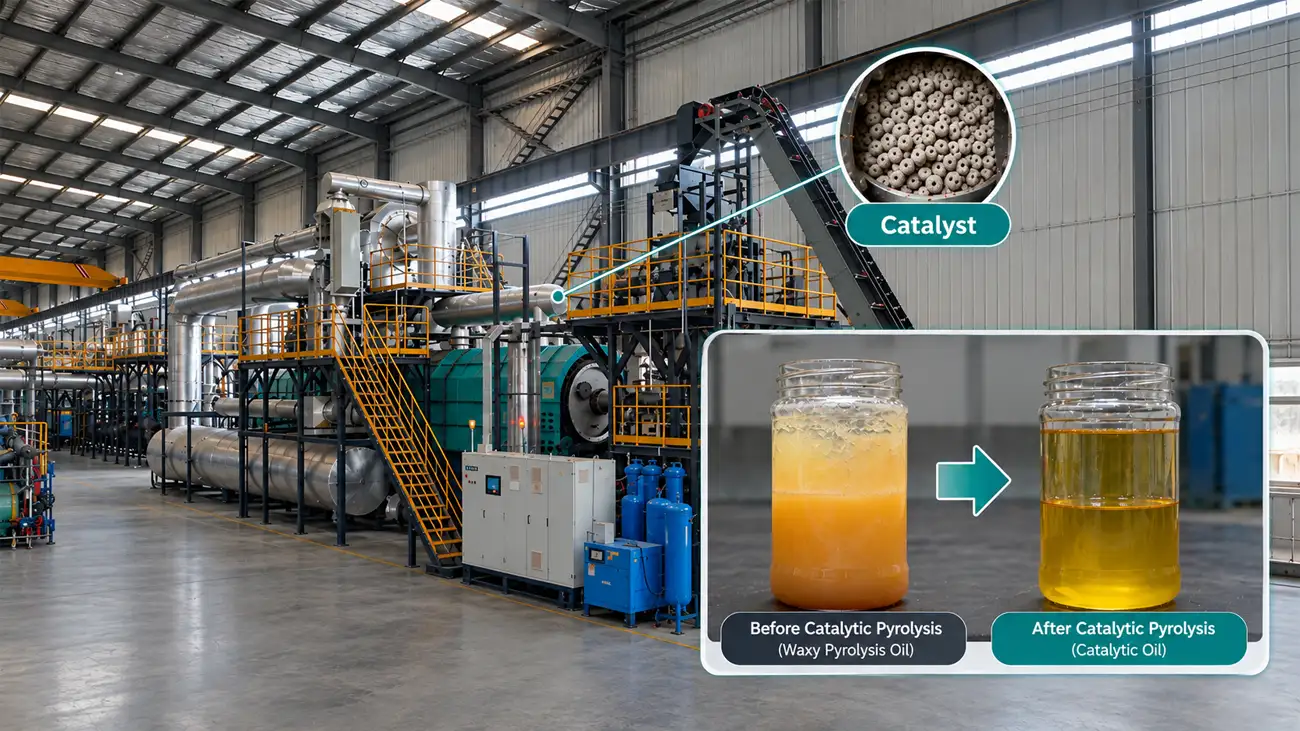
01 Industry Challenge: Wax Formation
In common plastic pyrolysis, certain feedstock compositions or improper reaction conditions produce paraffin wax. It is a high-viscosity solid at room temperature. The wax easily sticks to equipment’s inner surfaces, causing blockages and operational issues.
02 Technical Solution: Catalytic Pyrolysis
This patent utilizes catalytic tower design and special catalysts to decompose wax oils produced during plastic pyrolysis. Beston Group offers 2 configuration solutions: single or dual-catalyst tower design. Contact us to inquire plastic to oil machine!
03 Key Benefits of Catalytic Plastic Pyrolysis
- 200% Increase in Production Efficiency: Prevent wax oil clogging pipes, ensuring smooth machine operation and reducing maintenance needs.
- ISCC-Compliant Pyrolysis Oil Output: 100% liquefying wax oil, enhancing pyrolysis oil quality. Support customers in meeting international sustainability standards (ISCC) and strengthen market competitiveness.
- Enhanced Operational Safety: Reduces pressure fluctuations risks caused by clogged pipes, enhancing equipment safety during operations.
Step-by-Step Plastic Pyrolysis Process
Step 1: Raw Material Feeding
Waste plastics are loaded into the reactor manually, via an screw feeder, or through a feeder, followed by airtight sealing.
Step 2: High-Temperature Pyrolysis
The reactor is heated using natural gas, oil, biomass, or LPG. As internal temperatures reach 280°C to 450°C, thermal breakdown occurs, rapidly decomposing long-chain polymers into a continuous stream of oil-gas vapor.
Step 3: Oil-Gas Condensation
The oil-gas passes through a multi-stage tubular condensing system:
- Light Fraction: Condenses into liquid oil and drains into storage tanks.
- Heavy Fraction: Condenses and drops down into heavy oil tank.
Step 4: Syngas Recycling
Non-condensable gas is purified through a water seal and redirected back to the furnace as free auxiliary fuel, dramatically cutting heating costs.
Step 5: Solid Residue Recovery
After cooling, the auto-discharging system extracts solid carbon black residue in a fully enclosed environment to prevent dust pollution.
Step 6: Exhaust Gas Treatment
Combustion exhaust gas undergoes multi-stage scrubbing, desulfurization, and dedusting before being safely emitted in compliance with strict EU standards.
Waste Plastic Types for Pyrolysis: A Quick Guide
Not all plastics are suitable for pyrolysis. Polyethylene (PE), polypropylene (PP) and polystyrene (PS) convert well into pyrolysis oil, while PET and PVC should be kept out of the feedstock because they cut oil yield and cause equipment and emission problems. Use the table below to check your waste plastic.
| Resin code | Plastic | Suitability | Why |
|---|---|---|---|
| 1 | PET | Not suitable | Contains oxygen, so oil yield is low; can form deposits that block pipes |
| 2 | HDPE | Suitable | High oil yield |
| 3 | PVC | Not suitable | Releases hydrogen chloride (HCl), which corrodes the reactor and contaminates the oil |
| 4 | LDPE | Suitable | High oil yield |
| 5 | PP | Suitable | High oil yield |
| 6 | PS | Suitable | Yields oil rich in aromatics |
| 7 | Other | Case by case | Composition varies; send a sample for testing |

What Kind of Oil Can You Get from a Plastic Pyrolysis Plant?

Light Oil
Properties: Lighter color and lower viscosity than non-standard diesel.
Typical uses:
- Fuel for boilers, furnaces and heating systems
- Refined into naphtha and used as steam-cracker feedstock for ethylene and propylene production.
- Solvent and chemical feedstock

Non-Standard Diesel
Properties: Medium viscosity and relatively high calorific value.
Typical uses:
- Fuel for generator sets and industrial burners
- Fuel for heavy machinery where automotive diesel specifications are not required, such as marine vessels, construction equipment, and agricultural machinery.

Gasoline Blending Components
Properties: High aromatic and olefin content and a high octane value.
Typical uses:
- Blended into gasoline production at refineries to improve octane rating
Oil Yield of Beston Plastic Pyrolysis Plants by Plastic Type
Oil yield depends mainly on the type and cleanliness of the plastic. In our tests, clean, single-type PE gives 85–95% oil, and PP and PS give 80–90%. Mixed or contaminated waste gives less, so we recommend sorting it first.
| Feedstock | Oil yield | Basis |
|---|---|---|
| PE (HDPE, LDPE) | 85-95% | Test reports: HDPE (PDF), LDPE (PDF) |
| PP | 80-90% | Test report: PP (PDF) |
| PS | 80-90% | – |
| Plastic bottle caps | 80% | Test report: bottle caps (PDF) |
| Pure plastic cable | 60-80% | In-house test |
| Pure white plastic | 60–70% | – |
| Clean plastic bags / Sinking material | ~50% | In-house test |
| Fishing nets and safety nets | 45-50% | In-house test |
| ABS/Instant noodle packaging | 40% | In-house test |
| Household garbage | 30-50% | In-house test |
| Paper mill scraps | 20-30% | In-house test |
| Plastic trademark | 20% | In-house test |
Benchmark Case: Plastic Pyrolysis Project in Finland
Project Information
- Customer: Corsair Group
- Location: Jämsä, Finland
- Project Configuration: 3 × BLJ-16 plastic pyrolysis units
- Annual Processing Capacity: 4,000 tons/unit (total 12,000 tons)
- Plastic Pyrolysis Oil Use: Sold as fuel
- Start of Operation: 29 October 2025
Project Status
- Results(Phase 1 — 3 units running)
- ~7 tons/day processing capacity per unit
- ~70% oil yield
- Product certified ISCC+
- Recognized by Shell, with a long-term offtake agreement secured
- Phase 2 (7 additional units) now in procurement
“When our Finnish client first came to us, the real issue wasn’t equipment — it was that their existing oil couldn’t meet Europe’s high-end market standards. Through custom catalytic optimization, we helped them cut wax content, lower the pour point, and lift product quality to ISCC+ certified, Shell-recognized grade. The real value of pyrolysis isn’t simply turning waste plastic into oil — it’s helping customers produce a green product the market trusts, and one that creates greater commercial value.”
— Ms. Dou, Senior Project Manager, Beston Group


Technical Breakthrough & Advantages of Beston Plastic Pyrolysis Plant
01 Continuous Type: Blackgold P30

Zero Clogging & Minimize Coking
Precise temperature control and self-cleaning systems avoid condenser clogging. Mechanical chain friction and hot air heating technology minimize furnace coking. Thus, Blackgold P30 enables 720h continuous operation.
Get Light Oil & Non-standard Diesel
The oil-gas spray system directly achieves fraction cutting between light and heavy components, saving on distillation equipment investment while reducing energy consumption.
High Automation: ↑ 60% Production Efficiency
Blackgold P30 features automatic reactor temperature control (±10°C precision), automated weighing and feeding, and automatic fractional condensation. Together, these boost efficiency by 60% and minimize manual intervention.
Safety Compliance Operation
Self-adjusting mechanical design + nitrogen sealing technology ensure safe, stable equipment operation, with a dynamic seal rated for 3 kPa.
02 Pyrolysis+distillation Batch Type: BLJ-20

One Step to Get Light Oil & Non-standard Diesel
Fractional distillation technology allows simultaneous separation and collection of light oil (< 200℃) and non-standard diesel (>200℃).
- increases product value;
- no need for additional distillation equipment;
- lowers operating costs.
Increase Processing Capacity by 50%
The large-capacity plastic pyrolysis reactor (ø2800*10000) can process 12–13 tons of plastic waste per day. For your pyrolysis projects, this means:
- faster processing cycles;
- higher return on investment;
- stronger market competitiveness.
High Safety Factor
Thermal dynamic sealing & flexible high-temperature insulation technology greatly enhances machine and worker safety, delivering:
- superior furnace sealing, no oil-gas leaks
- no open flames & minimal thermal hazards
- stable furnace temperature
03 Common advantageous design for Blackgold P30/BLJ-20/BLJ-16
Multiple Security Design
Plastic to fuel machine has multiple designs to ensure safety, such as temperature gauges, pressure indicators, explosion-proof valves, and the sealed feed system.
Eco-friendly Design
The waste emissions from this equipment meet the standards. Treated by environmental protection facilities, the combustion exhaust gas meets the emission standards. After treatment of a water cooling system, carbon black can be discharged. This can reduce dust pollution.
Long Service Life
Our products are built with top-grade materials, crafted using expert welding techniques, and undergo rigorous quality inspections throughout production. This ensures a product lifespan of 5-8 years and offers excellent value for money.
Why Partner With Us: Full-Lifecycle Project Support

Tailored Engineering Solutions
Customized equipment sizing and process design engineered around your specific plastic feedstock, operational goals, and local emissions laws.
Industrial-Grade Manufacturing
Fabricated with durable, corrosion-resistant materials to ensure long-term stability and high processing efficiency under heavy continuous workloads.
Installation & Commissioning
Complete technical guidance for assembly, pipe connection, and system debugging to guarantee a fast, hassle-free startup.
Proactive After-Sales & Training
Hands-on operator training, preventative maintenance guidance, and reliable lifetime spare parts supply for uninterrupted profitability.
Sustainable Future Starts with Plastic Pyrolysis

Waste Reduction
Over 400 million tons of plastic are produced worldwide each year, with one-third used only once before being discarded. Pyrolysis effectively breaks down this waste plastic into oil, gas, and carbon black — diverting it from landfills and incinerators.
- Reduces the volume of accumulated plastic waste
- Lessens reliance on landfills and incineration facilities
- Improves air, soil, and water quality
Supports UN SDG 12 (Responsible Consumption and Production) and SDG 11 (Sustainable Cities and Communities)
Waste Resourcing
For businesses looking to upcycle discarded plastic, a pyrolysis plant offers a practical path forward. It transforms waste plastic into valuable pyrolysis oil, syngas, and carbon black — resources with real applications across industrial fuel, petrochemical, and materials sectors.
- Reduces dependence on finite fossil fuel resources
- Promotes circular economy development
- Creates new revenue streams from waste that would otherwise be a disposal cost
Supports UN SDG 7 (Affordable and Clean Energy) and SDG 9 (Industry, Innovation and Infrastructure)

ISO & CE Certificates of Tyre Pyrolysis Plant


FAQ About Waste Plastic Pyrolysis Machine
01 What types of plastic can be processed by pyrolysis?
The plastic pyrolysis plant accepts a wide range of waste plastics, including PE, PP, PS, and ABS, as well as mixed plastic waste. PVC and PET are refused for pyrolysis.
02 What’s the feeding size requirement for plastic pyrolysis machine?
Batch Pyrolysis Plants: Typically use manual or hydraulic feeding systems, which can accept whole or unshredded plastics directly.
Fully Continuous Pyrolysis Plants: Utilize continuous screw feeders, requiring plastic granules size ≤15mm.
03 What are the operating temperature and pressure for plastic pyrolysis?
- The normal operating reaction temperature is 280–350°C. Oil begins to distill at 180°C, and peak oil output occurs between 280°C and 350°C.
- The working pressure does not exceed 20 kPa.
04 What are the power, water and fuel consumption of plastic pyrolysis machine?
Consumption varies by equipment model.
- Fuel consumption: 40–50 L/h for diesel/heavy Oil, or 47–50 m³/h for natural gas (per 400,000 kcal burner).
- Water consumption: 0.3–0.5 tons/day for BLJ-16 batch unit; 5–8 tons/day for Blackgold P30 continuous unit.
- Power consumption: Exact figures depend on the specific equipment model.
05 How much pyrolysis oil can be produced from the plastic input?
Oil yield depends on feedstock type and purity, typically ranging from 60% to 90%. Cleaner, drier plastic waste generally produces higher oil output.
06 Is the pyrolysis process environmentally compliant?
Yes. The system operates in an oxygen-free, sealed reactor and is equipped with dedusting, desulfurization, and condensation units to control emissions in line with EU standard.
07 What after-sales support is provided?
We provide installation guidance, operator training, spare parts supply, and ongoing technical support to ensure long-term, stable operation.
Contact Beston Group for Plastic Pyrolysis Solution
Beston Group has a proven track record of successful pyrolysis project installations worldwide. Through studies about the cases of oil sludge/plastic/tyre/rubber pyrolysis plant, you can gain insights into the performance and profitability of our pyrolysis solutions. If you have any inquiries, feel free to contact us! Follow us on YouTube/Facebook/Linkedin/Pinterest for regular updates.