Tyre Pyrolysis Plant

Tyre Pyrolysis Plant Banner

A tyre pyrolysis plant heats scrap tires in an oxygen-free reactor to break down rubber polymers into valuable reusable resources. It converts waste tires into roughly 40% pyrolysis oil, 30% recovered carbon black, 20% steel wire, and 10% combustible syngas. It provides an eco-friendly circular economy solution for tire recycling.
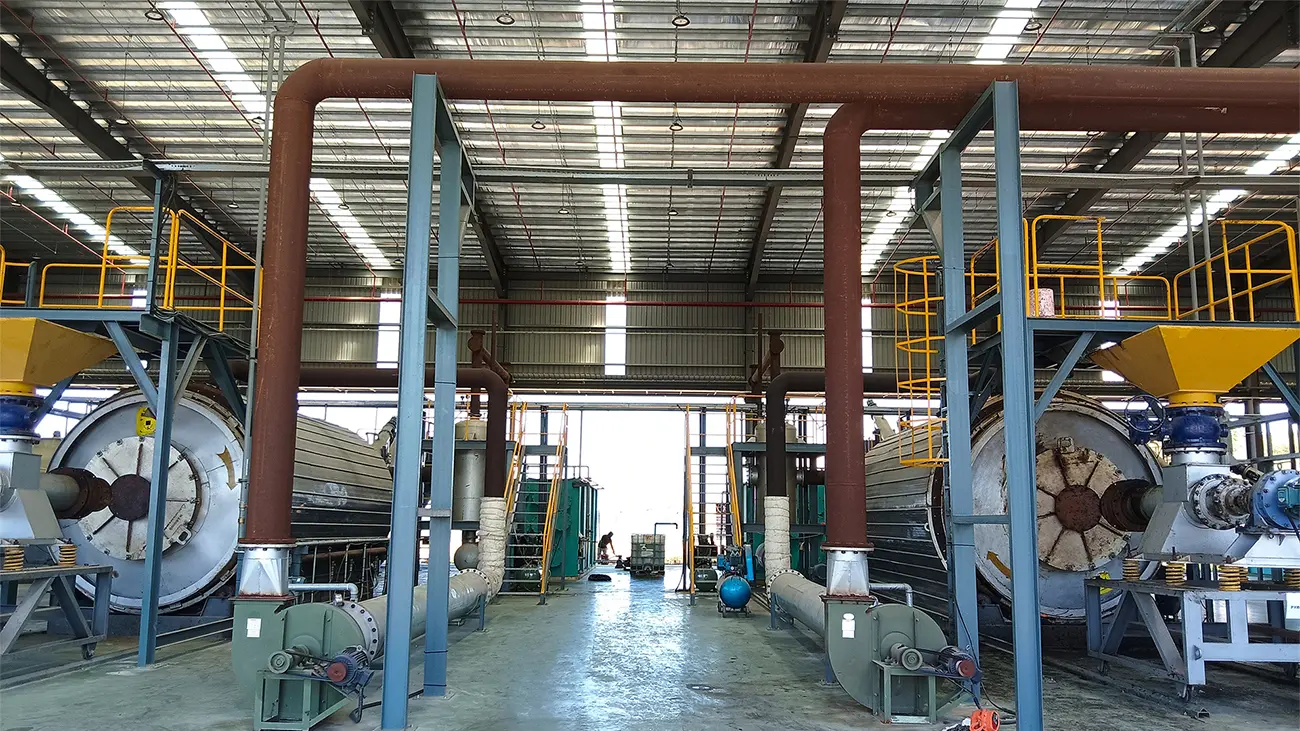
Waste Tyre Pyrolysis Plant in Operation Project
A waste tyre pyrolysis plant recycles waste tyres into pyrolysis oil, carbon black, steel wire, and syngas. (Credit: Beston Group)

Tyre Pyrolysis Plant Models & Specifications: Fully Continuous & Batch
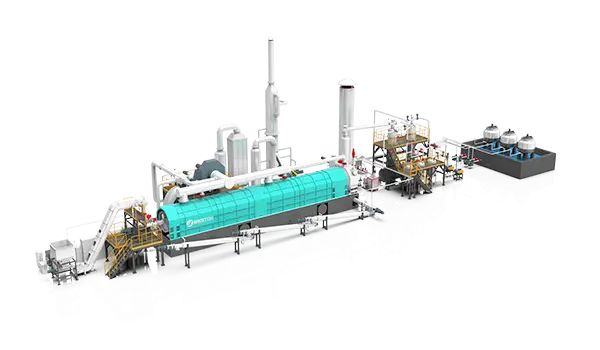
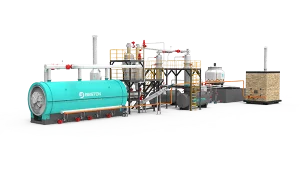
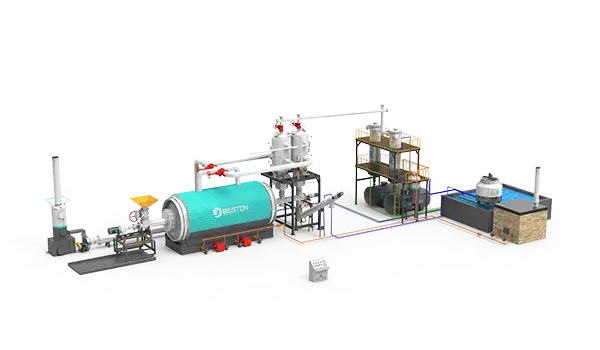
Blackgold P30 Tyre Pyrolysis Plant for Sale

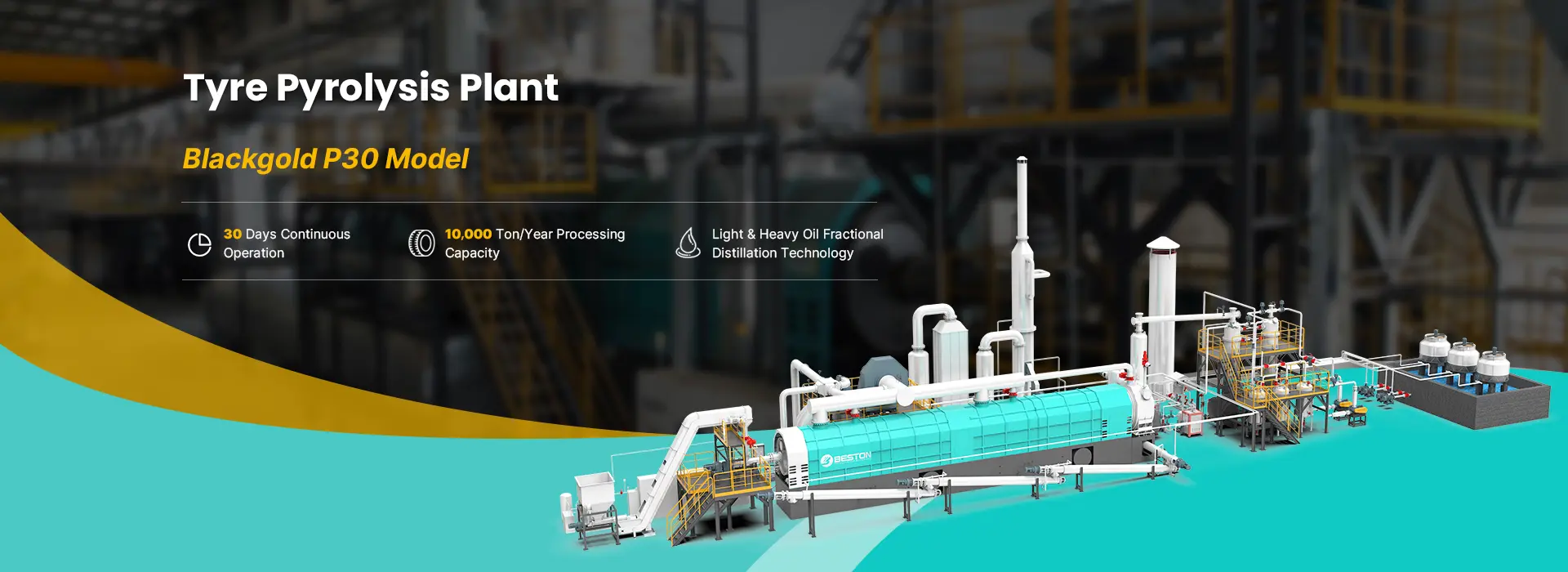
Continuous Type: Blackgold P30

  • Process 10,000 tons of tyres annually
  • 30-day continuous pyrolysis operation
  • High automation: 4 operators required
  • Get light oil & non-standard diesel
  • Policy support and incentives
  • Easy to get environmental compliance and approval
01 / 03
Blackgold P30 Tyre Pyrolysis Plant for Sale
Blackgold P30
BLJ-20 Tyre Pyrolysis Plant for Sale
BLJ-20
BLJ-16 Tyre Pyrolysis Plant for Sale
BLJ-16
ModelBlackgold P30BLJ-20BLJ-16 StandardBLJ-16 ULTRA
ManufacturerBESTONBESTONBESTONBESTON
Time to Market2026202520132022
Motor BrandChinese brandChinese brandChinese brandABB Explosion-proof
Suitable Raw MaterialsWaste plastics; Tires; Oil sludgeWaste plastics; Tires; Oil sludgeWhole tire<120cm;
Tire blocks<15cm;
Oil soil with liquid content<30%
Waste plastics; Tires; Oil sludge
Input Capacity (Max.)Waste plastic pellets: 0.8-1.05t/h;
Rubber powder: 1.25-1.5t/h;
Oil sludge:1.8-2.3t/h
Waste plastic pellets: 12-13t/d;
Tire: 18-20t/d;
Oil sludge:20-25t/d
Whole tire <120cm or Tire blocks<15cm: 10-12t/batch;
Sidewall removed tire: 15-16t/batch;
Oil soil: 16-18t/batch
Waste plastic bales: 8-10t/batch;
Whole tire <120cm or Tire blocks<15cm: 10-12t/batch;
Sidewall removed tire: 15-16t/batch;
Oil sludge: 16-18t/batch
Working MethodFully ContinuousBatchBatchBatch
Final Oil QualityPyrolysis oil;
Pyrolysis oil with wax or light oil;
Gasoline blending components
Pyrolysis oil;
Light oil and non-standard diesel
Pyrolysis oilPyrolysis oil;
Pyrolysis oil with wax or light oil
Reactor Material304/310S Stainless steelQ345R Boiler steel and 304/316L/310S Stainless steelQ345R Boiler steel304 Stainless steel
Reactor Life Span (Years)5-8 YearsQ345R Boiler steel: 2-3 Years;
304/316L Stainless steel: 5-8 Years;
310S Stainless steel: 8-10 Years
2-3 Years5-8 Years
Guarantee (Months)12121212
Delivery Time (Calendar Days)60-90604590
Land Space Required (L*W*H*m)50*20*1040*13*833*13*833*26*8
Packing20*6*3m in bulk+13*40HQ1*40FR+4*40HQ1*40FR+3*40HQ1*40FR+8*40HQ
Installation Period (Calendar Days)60-90454560

“Having overseen 40+ installations globally, I recommend the BLJ-16 as the essential entry-level solution for those prioritizing lower initial risk. In contrast, the Blackgold P30 represents the inevitable industry trend for large-scale industrial expansion, offering the high-efficiency, continuous operation required to dominate the market in 2026.”

— Feng, Senior Project Manager, 10+ years in cross-border project execution.

How the Tyre Pyrolysis Process Works: Step-by-Step Breakdown

Step 1: Feedstock Pre-treatment

Tires are either loaded whole (for batch systems) or shredded into small chips (20–50 mm) and cleared of heavy steel wires (for continuous systems).

Step 2: Sealed Feeding

Whole tires or pre-shredded tire chips are loaded into the reactor through a sealed feeding system, preventing air from entering and ensuring a fully oxygen-free environment. The reactor is then gradually preheated to prepare for the pyrolysis reaction.

Step 3: Thermal Decomposition

Under heating conditions (180℃450℃) and micro-negative pressure (<20kPa), rubber polymers crack into oil gas. Lighter oil gases ascend to condensers, while heavy oil is re-fed by the screw into the reactor for re-pyrolysis.

Step 4: Oil Gas Condensation

  • Oil condensation: Hot oil vapors pass through cooling pipes and condensers, turning into liquid pyrolysis oil, which is collected in storage tanks.
  • Syngas recycling: Uncondensable gases are cleaned and often recycled back to fuel the reactor’s burners.

Step 5: Solid Residue Recovery

After pyrolysis completes, carbon black is safely discharged via a water-cooled screw conveyor at stable, low temperatures. For batch systems, steel wires are extracted post-cooling for direct scrap recycling.

Step 6: Exhaust Gas Treatment

Exhaust gas undergoes a multi-step dedusting and scrubbing process (e.g., water spray) to ensure compliance with stringent global emission standards (such as EU or EPA).

Tyre Pyrolysis Products: Yields & Market Applications

Tyre Pyrolysis Oil

Tyre Pyrolysis Oil (TPO) | Yield: 40% – 45%

Our tyre to oil plant yield not only standard TPO but also high-value light oil and non-standard diesel, serving a wide range of industrial needs:

  • Industrial Fuel: High-caloric energy source for steel mills, cement plants, and glass factories.
  • Refinery Feedstock: Can be distilled into non-standard diesel for generators and heavy machinery.
  • Deep Upgrading: Used as a blending component to produce commercial-grade gasoline and diesel.
Carbon Black

Recovered Carbon Black (rCB) | Yield: 30% – 35%

Tyre pyrolysis carbon black (rCB) is no longer a byproduct but a high-value commodity. Here is how it powers modern industries:

  • Construction & Infrastructure: Manufactured into carbon bricks or used as a high-strength additive in asphalt and concrete.
  • Industrial Manufacturing: Applied as a functional filler and pigment in the production of rubber, plastics, inks, and professional coatings.
  • High-End Upgrading (N550/N660): Through grinding and pelletizing, it can be upgraded into high-purity grades like N550 or N660, increasing market value by up to five times.
Steel Wire

Steel Wire Scrap | Yield: 12% – 15%

Steel wire can be sold to steel mills or recycling companies, where to be reused in tire production or reprocessed into other metal products.

Combustible Gas

Combustible Syngas | Yield: 5% – 7%

This non-condensable syngas is a key factor in lowering your OpEx. It is recycled to heat the reactor, achieving energy self-sufficiency.

SGS Test Reports: Tyre Pyrolysis Oil, Carbon Black & SynGas Analysis

Tyre Pyrolysis Oil – SGS Physical & Chemical Analysis

Our advanced condensing system ensures high-quality tyre pyrolysis oil (TPO) with high calorific value and low viscosity, making it a premium alternative fuel for industrial boilers, steel plants, and heavy machinery, or a direct feedstock for oil distillation plants.

PROPERTY RESULT UNITS
Density at 20°C 0.9331 g/cm³
Kinematic Viscosity at 40°C 5.084 mm²/s
Kinematic Viscosity at 100 °C 0.7058 mm²/s
Pour Point <-57 °C
Cleveland Flash Point (Open cup) <79 °C
Gross Heat of Combustion 40.495 MJ/kg
Ash from Petroleum Products
Ash
0.010 % (m/m)
Total Sulfur Content 0.681 % (m/m)
Acid Number (Inflection end‑point) 0.8 mg KOH/g

Download TPO Test Report

Recovered Carbon Black (rCB) – SGS Report

Independent SGS testing confirms that recovered carbon black (rCB) from Beston equipment features high carbon purity. When further processed with our deep-grinding system, it serves as a high-value substitute for semi-reinforcing commercial carbon black.

Test Items Result
Ash 20.91 %
Total Sulfur 2.81 %
Gross Calorific Value 27.17 MJ/kg
Apparent Density 272 g/l
C 76.26 %
Si 0.056 %
Zn 20.6 %
Ca 8.26 %
Fe 1.20 %
Al 0.389 %
Cl 0.192 %
Oxygen,d 5.90 %

Download rCB Test Report

Non-Condensable Combustible Gas (SynGas) – SGS Safety & Emission Analysis

Purified through our multi-stage gas scrubber and anti-flashback water seal, the syngas is completely recycled to heat the furnace. SGS gas chromatography confirms high heating efficiency and non-hazardous emissions.

Test Item Test Result (%)
Methane 15.28
Ethane 3.62
Ethylene 2.88
Propane 3.59
Propylene 3.05
Isobutane 1.49
N-butane 0.86
N-butene 0.59
Reverse Butene 16.85
Carbon dioxide 12.73
Oxygen 0.54
Nitrogen 12.08
High level heat generation (20°С,101.3kPa) 12429 kcal/m³
High level heat generation (20°С,101.3kPa) 51.97 MJ/m³
Low heat generation (20C,101.3kPa) 48.04 MJ/m³
Low heat generation (20C,101.3kPa) 11487 kcal/m³

Download Syngas Test Report

Feedstock Yield Analysis: How Different Tires Impact Output

💡 Tip: “Based on our actual project experience in regions like South Africa and Brazil, we find that tires with high natural rubber content and low steel/cord impurities—such as OTR and large truck tires—are the gold feedstocks for pyrolysis. If you have a stable supply of these premium tires, pyrolysis often delivers a higher ROI than traditional mechanical recycling (producing low-margin rubber powder).”

Pyrolysis Oil Yield of Various Waste Tire Types
Pyrolysis Oil Yield of Various Waste Rubber Types
Raw MaterialTypesTyre Pyrolysis Oil (TPO)Recovered Carbon Black (rCB) Steel WireCombustible Gas
Tyre Truck Tires45%-50%30%15%-20%5%-10%
Car Tires40%-45%40%10%-15%5%-10%
Bicycle/motorcycle Tires30%-35%10%5%-10%5%-10%
Rubber ProductsRubber Cable25%-35%
Shoes Sole25%-35%
Mixed Sole20%-30%
Sneakers20%-30%
Waste Fiber Carpet30%
PMMA40%

Note: Data based on internal laboratory tests. Actual yields may vary slightly depending on the moisture content and rubber purity of the feedstock.

How We Verify Yield Rates: In-House Test Records Disclosed

To ensure the yield data we share is verifiable, our lab engineers run repeated small-batch tests on tyre feedstock from different sources and conditions — and we publish the raw records as-is: sample weight, reaction time, temperature curve, and unedited photos. Below are three of our most recent test records.

All Steel Tire Granules
Raw Material: All-Steel Tire Granules
Pyrolysis Oil from All-Steel Tire Granules
End Product: Pyrolysis Oil
Carbon Black from All Steel Tire Granules
End Product: Carbon Black
  • Material: All-steel tire granules
  • Sampling weight: 150g
  • Reaction time: 2 h 58 min
  • Temperature: 347°C
Table: Pyrolysis Results
Composition Unit/g Ratio/%
Pyrolysis Oil 37g 24.67%
Carbon Black 38g 25.33%
Combustible Gas 33g 22%

Download Test Report


Tire Fragments
Material: Tire Fragments

Pyrolysis Oil from Tire Fragments Pyrolysis
End Product: Pyrolysis Oil

Carbon Black from Tire Fragments Pyrolysis
End Product: Carbon Black

  • Material: Tire fragments
  • Sampling weight: 500g
  • Reaction time: 2h 41min
  • Temperature: 284°C
Table: Pyrolysis Results
Composition Unit/g Ratio/%
Pyrolysis Oil 187g 37.40%
Carbon black 217g 43.40%
Combustible Gas 96g 19.20%

Download Test Report


Shredded Tires from Indonesia
Material: Shredded Tires

Pyrolysis Oil from Shredded Tyres Pyrolysis
End Product: Pyrolysis Oil

Carbon Black from Shredded Tyres Pyrolysis
End Product: Carbon Black

  • Material: Indonesia shredded tyres
  • Sampling weight: 200g
  • Reaction time: 1h 54min
  • Temperature: 371°C
Table: Pyrolysis Results
Composition Unit/g Ratio/%
Pyrolysis Oil 90g 45%
Carbon black 73g 36.50%
Combustible Gas 37g 18.50%

Download Test Report

Global Project Cases: Proven Success Across 30+ Countries

Tyre Pyrolysis Project in South Africa

Project Background 

As a leading metal and integrated waste recycler in South Africa, the client faced a dual challenge:

  • Challenge 1: The Waste Dilemma — Their recovery network generated thousands of tons of waste tires and plastics annually, requiring an effective volume-reduction solution.
  • Challenge 2: High Fuel Costs — Concurrently, their metal smelting operations were burdened by rising energy expenses, driving an urgent need for alternative fuels.

Project Overview & Status

  • Annual Capacity: 6,000 t waste tires & 4,000 t waste plastics
  • Configuration: 2 × BLJ-16 (Q345R) pyrolysis plants + 1 × BZJ-10 distillation equipment
  • Pyrolysis Oil Use: Fuel for aluminum melting and heavy-duty trucks
  • Operation Date: In successful operation since Feb 26 2025
  • Operational Results: Maintains a stable supply of pyrolysis oil for internal use. This closed-loop energy model significantly offsets the client’s furnace fuel costs.
BLJ-16 Tire to Oil Plant in South Africa
Tire Waste Feedstock to Recycle Oil
Tire Pyrolysis Oil Produced On-site South Africa
Tire Pyrolysis Oil Produced On-site
Tyre to Oil Pyrolysis Project in South Africa

Tyre Pyrolysis Project in West Africa

Project Background 

The client is a waste recycling company based in West Africa, currently expanding its resource recovery portfolio by developing pyrolysis capabilities. The primary objective of this initial waste tire project is to gain operational expertise and develop a skilled technical team, providing a foundation for the future integration of plastic and oil sludge pyrolysis operations.

Project Overview & Status

  • Annual Capacity: 6,000 tons of waste tires
  • Equipment Configuration: BLJ-16 model with a dual-system setup (Manifold + Catalytic Tower), engineered to support future processing of waste plastics and oil sludge for feedstock diversification.
  • Launch Date: June 2024
  • Pyrolysis Oil Use: sold as fuel
  • Project Status: Installation and commissioning have been successfully completed. The system is currently in stable operation.
Whole Tires Feed in Pyrolysis Reactor
Tyre Pyrolysis Plant in West Africa
Tyre Pyrolysis Carbon Black
The pyrolysis oil produced by the African project's tires
Tyre pyrolysis oil

More Tyre Recycling Cases

Blackgold P30 & BLJ-20 Plastic to Oil Machine: Latest Technical Breakthrough

Blackgold P30 Technical Breakthrough

Technical Innovations of Beston BLL-30 Oil Sludge Pyrolysis Plant

Wax Recovery System & Anti-coking Design

Zero Clogging & Less Coking: 30 Days Continuous Operation

Blackgold P30 utilizes steam heating with co-current self-cleaning to prevent wax clogging, and mechanical gravity-friction with uniform hot-air heating to mitigate coking. These ensure 300 days of annual operation and boost profitability.

Light & Heavy Oil Fractional Distillation System

Collect Light Oil & Non-Standard Diesel

Blackgold P30 uses an oil-gas spray technology to fractionate light oil and non-standard diesel, collecting 8 tons more light oil per day than before. (Extra revenue: 8 tons × 320 RMB/ton = 2,560 RMB/day → 2,560 × 300 days = 768,000 RMB/year)

Automatic Technology

High Automation & Min Manual Labor

Blackgold P30 features automatic reactor temperature control (±10°C precision), automated weighing and feeding, and automatic fractional condensation. Together, these boost efficiency by 60% and reduce labor costs by the equivalent of 2 workers.

Self-adjusting Sealing Technology

Safety Upgrade & Compliant Operation

BlackGold P30 features automatic sealing based on variable thermal deformation and nitrogen sealing technology. Dynamic sealing withstands 3 kPa pressure.

BLJ-20 Technical Breakthrough

BLJ-20 Oil Sludge Pyrolysis Equipment Technical Upgrade

Fractional Distillation Technology

One Step to Get Light Oil & Non-standard Diesel
  • Energy saving & consumption reduction: Reduce heating and cooling loads.
  • Product optimization: High light component yield and sufficient heavy component recovery.
  • Investment optimization: Reduce intermediate equipment, resulting in lower floor space and capital expenditures.

Large-capacity Pyrolysis Reactor (ø2800*10000)

Increase Processing Capacity by 50%
  • Larger recycling scale: Improves processing capacity to 18-20 tons/day. Annual tire treatment capacity up to 6,000 tons, ideal for medium to large projects.
  • Better Economic Return: Improved equipment utilization and generated more revenue from oil products.

Thermal Dynamic Sealing & Flexible High-temp Insulation Technology

High Safety Factor
  • Leakage Prevention: Improved sealing prevents the escape of oil and gas.
  • Flameless Operation: Minimizes fire risk and hazards.
  • Reduced Heat Hazards: Advanced insulation blocks heat radiation, safeguarding operators.

Engineering Excellence: Key Advantages of Beston Tyre Pyrolysis Plant

Oil Sludge Pyrolysis Plant

Operational Efficiency: Lowering Your OPEX

  • Syngas Self-Sufficiency: The system recycles non-condensable gases back to the furnace as fuel. This Syngas Recycling System dramatically reduces external energy costs and lowers overall emissions.
  • Advanced Heat Retention: Our tyre pyrolysis reactor is wrapped in high-density insulation casing, ensuring maximum thermal efficiency and less energy cost.

Safety First: Proactive Risk Mitigation

  • Nitrogen Replacement: Before ignition and slag discharge, nitrogen is introduced to displace oxygen. This creates an inert environment, effectively preventing flash explosions
  • Overpressure Alarm & Automatic Pressure Relief: In the event of overpressure in the main furnace, the safety valve will be automatically opened for emergency pressure relief to ensure equipment safety and personal safety.
  • Multi-Point Monitoring: Multiple observation points provide real-time tracking of temperature, pressure, and liquid levels for total operational transparency.

Eco-Friendly Compliance: Frictionless Permit Approval

  • Modular Dedusting: Various dedusting treatments (water washing, spraying, ceramic ring adsorption, and activated carbon adsorption) to ensure meeting EU emission standard or your local standard.
  • Zero-Discharge Cooling: Recycles 100% of cooling water to minimize resource consumption and prevent thermal pollution.
  • Enclosed Clean Operation: From feeding to carbon black discharging, the entire process is fully enclosed to eliminate dust pollution.

Intelligent Control: Precision Operations

  • PLC/DCS Automation: Our centralized control systems (available in PLC or DCS configurations) allow for remote monitoring and operation. This reduces on-site labor requirements by up to 40% while keeping operators at a safe distance from the heat zone.
  • IoT & Remote Diagnostics: With integrated IoT Technology, our engineers can provide remote technical support and real-time monitoring of your equipment’s health, ensuring maximum uptime and predictive maintenance.

Beyond Disposal: Why Pyrolysis Outperforms Traditional Tire Treatment

Environmental Benefits

  • Avoid Negative Environmental Impacts: Discarded tires take up significant space and degrade slowly in nature; long-term stockpiling can also pose environmental risks, such as mosquito breeding, fire hazards and water pollution. 
  • Lower Lifecycle Carbon Footprint: Tire pyrolysis is conducted in an oxygen-deprived environment, reducing the generation of combustion-related emissions. Through resource recovery, this process also decreases reliance on virgin fossil resources and supports the use of low-carbon resources.

Economic Benefits

  • High-Value Product Sales: Pyrolysis generates key marketable outputs: fuel oil, steel wire, syngas, and raw carbon black. Driven by global sustainability mandates, the market demand for recovered Carbon Black (rCB) is surging, offering robust revenue potential.
  • Gate Fee / Waste Tonnage Income: By scaling operations up to industrial recycling hubs, operators can generate steady cash flow through gate fees (tipping fees) collected from tire manufacturers, waste management firms, and local municipalities for processing end-of-life tires (ELTs).
TechnologyUsage & FeaturesSecondary PollutantsFacility InvestmentROI & ValueLimitations
LandfillTraditional dumpingSoil and water pollutionLowNegative (Disposal fees)Prohibited in most countries.
RetreadingFor slightly worn tiresMinimalLowModerateOnly applies to 10% of waste tires.
IncinerationSuitable for tires that cannot be reusedHigh CO2 & toxic emissionsLowHighHigh environmental control costs
ShreddingRubber granules/powderDust & Noise pollutionLow (Market saturation)HighLimited market demand for recycled products; difficult to handle large volumes
Tire-Derived FuelIndustrial fuelSecondary solid (ash) and air (SO2, NOx, dioxins) pollutantsModerateHighHigh pollution control costs
PyrolysisTotal Resource RecoveryEco-friendlyHighLow/

Lifecycle Services: Your Partner from Consultation to Commissioning

Beston Group Offers Lifecycle Services

01 Professional Consultation & Site Planning

  • Technical Advisory: Expert consultation on technical Q&A, local emission standards compliance, and financial ROI estimation.
  • Customized Layouts: Tailored Process Flow Diagrams (PFD), 2D civil engineering drawings, and 3D site layout plans.

02 Manufacturing & Quality Control

  • Precision Manufacturing: Every system undergoes rigorous factory testing and quality inspections before shipment.
  • Logistics Support: Professional shipping coordination to ensure safe delivery to your global site.

03 Installation & Expert Commissioning

  • On-Site Guidance: Our senior technical team travels to your location to guide assembly and installation.
  • System Commissioning: Full trial runs and performance fine-tuning to ensure the system meets all operational benchmarks before handoff.

04 Personnel Training & Lifetime Support

  • Skill Transfer: We provide hands-on training for your local operators, covering safety protocols, maintenance, and PLC management.
  • 24/7 Technical Response: With our IoT-enabled remote support, we provide real-time diagnostics and rapid spare parts delivery wherever you are.

ISO & CE Certificates of Tyre Pyrolysis Plant

Beston Group ISO 9001 QMS Certificate

Beston Group ISO 14001 EMS Certificate

Beston Group CE Certificate

FAQ About Waste Tyre Pyrolysis Machine

01 What are the operating temperature and pressure for tire pyrolysis?

  • The normal operating reaction temperature is 280–350°C. Oil begins to distill at 180°C, and peak oil output occurs between 280°C and 350°C.
  • The working pressure does not exceed 20 kPa.

02 What’s the feeding size requirement for waste tires?

Feeding size varies by equipment model (Batch vs. Fully Continuous) and feeding system:

1. Batch Pyrolysis Plant

  • Manual/Hydraulic Feeding: Whole tires ≤1200mm (1.2m) can feed directly. Tires larger than 1200 mm require shredding.
  • Screw Feeding: Tire particle size ≤50mm (5cm).

2. Fully Continuous Pyrolysis Plant

  • Continuous Screw Feeding: Requires wire-free rubber granules/powder size ≤15mm.
  • Shredding tires down to 10–15 mm achieves a 99% steel wire removal rate. Processing further to 1–5 mm is also acceptable, but significantly increases pre-treatment energy consumption.

03 Can your exhaust treatment pass EU standards? Do you have third-party test reports?

Yes. With our high-end flue gas dedusting system, the emissions easily meet strict EU standards. We also provide third-party SGS test reports.

  • SO₂ ≤ 50 mg/m³,
  • NOₓ ≤ 200 mg/m³
  • particulate matter ≤ 10 mg/m³
  • HCl ≤ 10 mg/m³
  • HF ≤ 1 mg/m³

04 What are the yield ratios of products from waste tire pyrolysis?

Typical product yields: 35%-45% pyrolysis oil, 30%-35% carbon black, 8%-15% combustible gas, 8%-15% steel wire.

Note: Yield ratios vary slightly based on tire composition—passenger car tires yield slightly less oil, while heavy truck tires yield higher oil output and better quality carbon black due to higher natural rubber content.

05 What are the power, water and fuel consumption of tire pyrolysis machine?

Consumption varies by equipment model.

  • Fuel consumption: 40–50 L/h for Diesel/Heavy Oil, or 47–50 m³/h for Natural Gas (per 400,000 kcal burner)
  • Water consumption: 0.3–0.5 tons/day for BLJ-16 batch unit; 5–8 tons/day for BLL-30 continuous unit.
  • Power consumption: Exact figures depend on the specific equipment model.

Start Your Tyre Pyrolysis Project with Beston Group

Start your tyre pyrolysis project with Beston Group today and turn waste into profit while reducing tyre pollution. With our cutting-edge technology and full-service support, we ensure your project’s success from start to finish. Ready to learn more? Visit Linkedin for detailed information and expert guidance.

    Contact Us

    The following items will help you identify key information about your project, which will enable us to work on a competitive solution proposal.

    Please specify your requirement by referring to the following aspects:

    1. What kind of solution will meet your demand? (Key point)

    2. What kind of end product are you planning to have? (Right solution begins from material and product)

    3. When is the project supposed to be running?

    4. Budget for machinery purchasing? (Key info for right model)

    5. Details on your raw materials and end product application.

    5. Points that you really focus on. (Customized service from our project consultant)