
Plastic pyrolysis process is an advanced chemical recycling process that breaks down plastic polymers at high temperatures under oxygen-free conditions, converting waste plastics into valuable pyrolysis oil and gases. This technology not only helps reduce reliance on landfilling and incineration but also provides alternative feedstocks for the energy and chemical industries. In this article, Beston Group will take you on an in-depth look at the core principles and practical value of plastic pyrolysis.
Technical Principles of Plastic Pyrolysis Process
Regular Technology: Plastic Pyrolysis
- Principle: Waste plastics are thermally decomposed at high temperatures under oxygen-deficient or oxygen-free conditions. The basic mechanism involves using heat to break the polymer chains of plastics, cracking large molecules into smaller ones and producing liquid oil, combustible gases, and a small amount of solid residue.
- Product Features: Pyrolysis oil containing wax.
- Current Application: Conventional pyrolysis is the most fundamental and widely applied process.
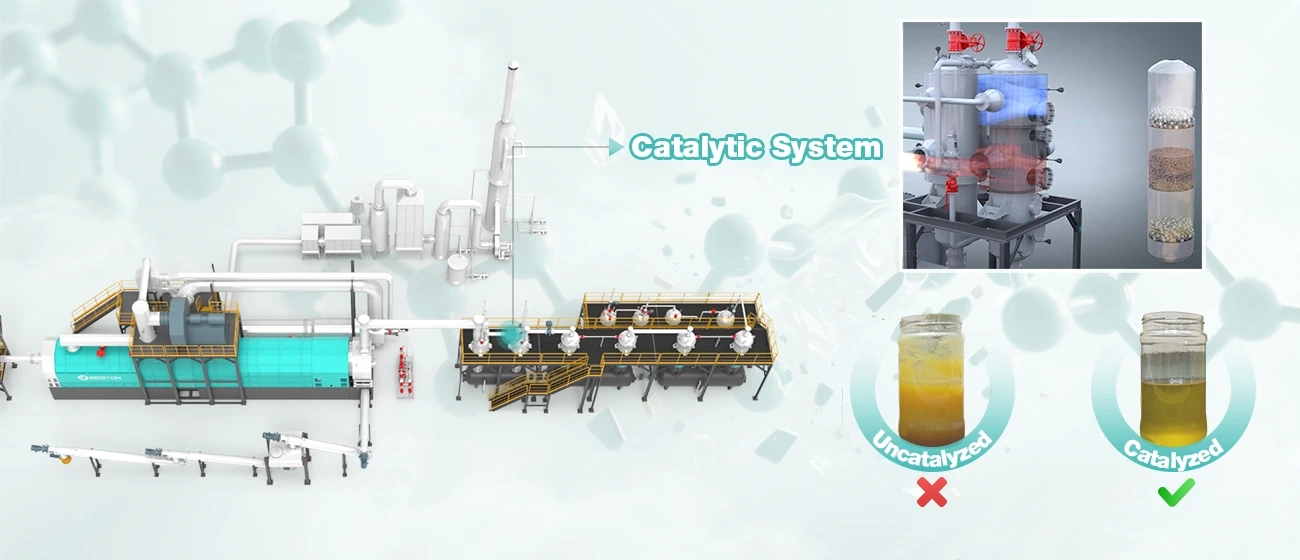
Extended Technology: Catalytic Plastic Pyrolysis
- Principle: Building upon conventional pyrolysis, catalysts—such as zeolites—are introduced to improve reaction efficiency and product quality.
- Product Features: High-quality pyrolysis oil.
- Industrial Outlook: With continuous advancements in catalytic materials and process optimization, catalytic pyrolysis is increasingly becoming a key direction for the large-scale commercialization of plastic pyrolysis.
- Advantages: Higher liquid oil yield with significantly improved oil quality. Lower energy consumption, enhancing economic feasibility. Reduced equipment clogging and minimized downtime losses.
Involved Equipment in Plastic Pyrolysis Process
To carry out plastic pyrolysis, a special machine called a plastic pyrolysis plant is used. It is built to withstand high temperatures and keep the process free of oxygen. This creates the right conditions for plastic waste to break down safely and turn into useful products.
| Model | Blackgold P30 | BLJ-20 | BLJ-16 Standard | BLJ-16 WAX | BLJ-16 CAT | BLJ-16 ULTRA |
|---|---|---|---|---|---|---|
| Manufacturer | BESTON | BESTON | BESTON | BESTON | BESTON | BESTON |
| Time to Market | 2026 | 2025 | 2013 | 2022 | 2022 | 2022 |
| Motor Brand | Chinese brand | Chinese brand | Chinese brand | Chinese brand | Chinese brand | ABB Explosion-proof |
| Suitable Raw Materials | Waste plastics; Tires; Oil sludge | Waste plastics; Tires; Oil sludge | Whole tire<120cm; Tire blocks<15cm; Oil soil with liquid content<30% | Waste plastic bales (Max.0.9*0.9*1.6m) | Waste plastic bales (Max.0.9*0.9*1.6m) | Waste plastics; Tires; Oil sludge |
| Input Capacity (Max.) | Waste plastic pellets: 0.8-1.05t/h; Rubber powder: 1.25-1.5t/h; Oil sludge:1.8-2.3t/h | Waste plastic pellets: 12-13t/d; Tire: 18-20t/d; Oil sludge:20-25t/d | Whole tire <120cm or Tire blocks<15cm: 10-12t/batch; Sidewall removed tire: 15-16t/batch; Oil soil: 16-18t/batch | 8-10t/batch | 8-10t/batch | Waste plastic bales: 8-10t/batch; Whole tire <120cm or Tire blocks<15cm: 10-12t/batch; Sidewall removed tire: 15-16t/batch; Oil sludge: 16-18t/batch |
| Working Method | Fully Continuous | Batch | Batch | Batch | Batch | Batch |
| Final Oil Quality | Pyrolysis oil; Pyrolysis oil with wax or light oil; Gasoline blending components | Pyrolysis oil; Light oil and non-standard diesel | Pyrolysis oil | Pyrolysis oil with wax | Pyrolysis oil with light oil | Pyrolysis oil; Pyrolysis oil with wax or light oil |
| Reactor Material | 304/310S Stainless steel | Q345R Boiler steel and 304/316L/310S Stainless steel | Q345R Boiler steel | 304 Stainless steel | 304 Stainless steel | 304 Stainless steel |
| Reactor Life Span (Years) | 5-8 Years | Q345R Boiler steel: 2-3 Years; 304/316L Stainless steel: 5-8 Years; 310S Stainless steel: 8-10 Years | 2-3 Years | 5-8 Years | 5-8 Years | 5-8 Years |
| Guarantee (Months) | 12 | 12 | 12 | 12 | 12 | 12 |
| Delivery Time (Calendar Days) | 60-90 | 60 | 45 | 60 | 60 | 90 |
| Land Space Required (L*W*H*m) | 50*20*10 | 40*13*8 | 33*13*8 | 33*13*8 | 33*13*8 | 33*26*8 |
| Packing | 20*6*3m in bulk+13*40HQ | 1*40FR+4*40HQ | 1*40FR+3*40HQ | 1*40FR+3*40HQ | 1*40FR+3*40HQ+1*20GP | 1*40FR+8*40HQ |
| Installation Period (Calendar Days) | 60-90 | 45 | 45 | 45 | 45 | 60 |
Plastic Pyrolysis Process Steps: Catalytic Pyrolysis Technology
01 Feeding
Feed plastic waste into plastic pyrolysis reactor. In the video, the batch plastic to oil machine adopts a hydraulic feeder. Remove the hydraulic feeder after feeding. The door must be closed and locked.